Canadian Pacific Kansas City Limited
Business Overview: Canadian Pacific Kansas City Limited (NYSE/TSX: CP)
Executive Summary
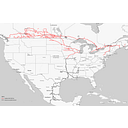
Canadian Pacific Kansas City Limited (CPKC) is the only freight railway spanning Canada, the United States, and Mexico, operating an approximately 20,000-mile network that connects major business centers across all three North American economies. The company was formed on April 14, 2023, when Canadian Pacific assumed control of Kansas City Southern, creating the first genuinely trilateral single-line rail network in North American history — a transaction that took years of regulatory review and remains subject to Surface Transportation Board (STB) oversight conditions, including gateway commitments and a seven-year monitoring period.
The single most decision-relevant fact for CPKC is that it is still in the multi-year process of integrating the KCS network and realizing the single-line service advantages that were the entire strategic rationale for the merger. Single-line service — moving freight from origin to destination without handing it off between railroads at a border interchange — is CPKC's central competitive pitch to shippers, since interchange handoffs add time, cost, and risk. The company generated total freight revenue of $14,776 million in 2025, split across three lines of business: Merchandise (46% of freight revenue, including energy/chemicals/plastics, metals/minerals/consumer goods, automotive, and forest products), Bulk Commodities (36%, led by grain at 22%), and Intermodal (18%, split between domestic and international containerized traffic).
CPKC's business is meaningfully seasonal — revenue is typically weakest in the first quarter due to winter operating conditions and strongest in the fourth quarter around the North American grain harvest — and roughly 10% of freight revenue is generated through fuel surcharges that pass through diesel price volatility to shippers. As a real, physical-network business with no near-term substitute for its trilateral rail footprint, CPKC's investment case centers on how much incremental volume and pricing power the completed Canada-U.S.-Mexico network can capture from trucking and other railroads as integration matures.
1. Core Business Model & How They Work
CPKC generates revenue by moving freight across its integrated rail network on a per-carload/unit basis, charging rates that reflect distance, commodity type, service level, and competitive alternatives. Key operational drivers include:
- Single-line network advantage — the ability to move freight from Canada through the U.S. into Mexico (or vice versa) without interchange handoffs is CPKC's primary structural differentiator versus railroads that must interchange with a connecting carrier at the border.
- Bulk commodity volumes — grain (22% of freight revenue), coal, potash, and fertilizer/sulphur moves depend on harvest conditions, global commodity demand, and CPKC's positioning in western Canada and U.S. plains grain-producing regions.
- Merchandise freight diversity — energy/chemicals/plastics, metals/minerals/consumer goods, and automotive shipments (the largest revenue category at 46%) provide diversified, less seasonally volatile revenue than bulk commodities.
- Intermodal container volumes — domestic and international containerized freight moving through major gateway ports (Vancouver, Lázaro Cárdenas, Montréal, Saint John) compete directly with long-haul trucking on cost and increasingly on service reliability.
- Fuel surcharge pass-through — approximately 10% of freight revenue comes from fuel surcharges that adjust with diesel prices, partially insulating margins from fuel cost volatility.
- Network integration execution — ongoing work to fully integrate KCS's Mexican and U.S. operations into CPKC's broader network, including compliance with STB-imposed gateway commitments and oversight conditions through the seven-year monitoring period following the 2023 merger.
- Transload and specialized service development — building out transload facility networks and specialized train services to compete more effectively against trucking, which benefits from publicly funded highway infrastructure that CPKC must instead build and maintain itself.
2. Business Segments
CPKC operates as a single integrated rail transportation segment but discloses freight revenue across three lines of business: Merchandise (46% of freight revenue: energy/chemicals/plastics 20%, metals/minerals/consumer goods 12%, automotive 9%, forest products 5%), Bulk Commodities (36%: grain 22%, coal 7%, potash 4%, fertilizers/sulphur 3%), and Intermodal (18%: domestic containers 10%, international containerized traffic 8%).
3. Product Portfolio
| Product/Category | Description | Target Market |
|---|---|---|
| Grain and agricultural products | Rail transport of grain from prairie/plains growing regions to export ports and domestic markets | Grain elevators, agribusiness, export terminals |
| Energy, chemicals & plastics | Bulk and unit-train movement of petrochemical and energy-sector products | Chemical manufacturers, energy producers |
| Metals, minerals & consumer goods | Mixed freight and unit trains for industrial and consumer product shippers | Manufacturers and industrial shippers |
| Automotive | Finished vehicle and auto parts transport | Automakers and parts suppliers |
| Coal, potash, fertilizer/sulphur | Bulk unit-train commodity transport | Mining companies, fertilizer producers, utilities |
| Domestic intermodal | Containerized domestic freight | Retailers, logistics companies, 3PLs |
| International intermodal | Containerized freight moving through Vancouver, Lázaro Cárdenas, Montréal, Saint John | Global shippers and ocean carriers |
4. Competitive Landscape
CPKC competes against other Class I railways — most directly Canadian National Railway (CN) in Canada, and Union Pacific, BNSF, Norfolk Southern, and CSX in the United States — as well as motor carriers (trucking companies), ship and barge operators, and pipelines for specific commodity flows. Competition is based on service quality, freight rates, transit time, and market access. Trucking competitors benefit from government-funded and maintained highway infrastructure, whereas CPKC must build, maintain, and finance its own rail network — a structural cost CPKC offsets by developing transload facilities and specialized train services that extend its effective reach into markets not directly rail-served. CPKC's unique trilateral network is, in principle, a competitive advantage no other single railway can currently match, since it alone offers single-line service across all three NAFTA/USMCA countries.
Key Competitors:
- Canadian National Railway (CN)
- Union Pacific
- BNSF Railway (Berkshire Hathaway)
- Norfolk Southern
- CSX
- Trucking carriers and barge/pipeline operators (commodity-specific competition)
5. Strategic Strengths & Risks
Competitive Strengths (The Moat)
- The only single-line railway spanning Canada, the U.S., and Mexico, a structural advantage that would be extraordinarily costly and practically impossible for a competitor to replicate given rail right-of-way scarcity and regulatory barriers to new rail construction.
- Classic natural-monopoly-style barriers to entry: rail networks require enormous fixed capital investment and cannot be economically duplicated, giving incumbents durable regional pricing power.
- Diversified freight mix across bulk commodities, merchandise, and intermodal reduces dependence on any single commodity cycle.
- Direct rail access to major gateway ports (Vancouver, Lázaro Cárdenas, Montréal, Saint John) positions CPKC advantageously for both North American and international trade flows.
Strategic Risks & Vulnerabilities
- Ongoing integration risk: fully realizing the single-line service benefits of the 2023 KCS combination requires continued operational and systems integration, and STB oversight conditions (gateway commitments, seven-year monitoring) constrain some commercial flexibility.
- Seasonality and weather risk: Q1 revenue is structurally weaker due to winter operating conditions, and severe weather events can disrupt network operations and cause cost spikes.
- Commodity cycle exposure: grain (22% of freight revenue) is sensitive to harvest yields and global agricultural trade dynamics, while coal and potash volumes depend on global energy and fertilizer demand cycles.
- Trucking competition on shorter-haul and intermodal lanes, particularly as trucking technology (efficiency, potential autonomous operation) evolves.
- Regulatory and cross-border policy risk given the trilateral Canada-U.S.-Mexico footprint, including potential tariff, trade policy, or USMCA-related disruptions that could affect cross-border freight volumes.
6. Financial Overview
| Metric | Value | Context |
|---|---|---|
| Total freight revenue (2025) | $14,776 million | Across Bulk, Merchandise, and Intermodal lines of business |
| Network size | ~20,000 miles | Only single-line railway spanning Canada, U.S., and Mexico |
| Merchandise revenue share | 46% of freight revenue | Largest line of business; includes energy/chemicals, metals/minerals, automotive, forest products |
| Bulk Commodities revenue share | 36% of freight revenue | Grain alone represents 22% of freight revenue |
| Intermodal revenue share | 18% of freight revenue | Split between domestic (10%) and international (8%) containerized traffic |
| Fuel surcharge contribution | ~10% of freight revenue | Passes through diesel price volatility |
| Merger milestone | KCS control assumed April 14, 2023 | Subject to STB gateway commitments and seven-year oversight |
7. Summary Conclusion
Canadian Pacific Kansas City holds a genuinely unique structural position in North American transportation as the only railway offering single-line freight service across Canada, the United States, and Mexico, a barrier-to-entry advantage that is essentially impossible for a competitor to replicate given the capital intensity and regulatory complexity of rail network construction. With $14.8 billion in 2025 freight revenue diversified across bulk, merchandise, and intermodal traffic, and continued integration of the 2023 Kansas City Southern combination still unlocking single-line service efficiencies, CPKC's investment case rests on management's ability to convert its network uniqueness into sustained volume growth and pricing power versus both other Class I railroads and trucking alternatives, while navigating cross-border trade policy risk and the STB's ongoing oversight conditions.