BONE BIOLOGICS CORPORATION
Bone Biologics Corporation (BBLG)
Executive Summary
Bone Biologics Corporation is a clinical-stage medical device company developing bone-regeneration products for spinal fusion surgery, trading on Nasdaq under BBLG. It is an extremely small company: two full-time employees (CEO Jeffery Frelick and CFO Deina Walsh), a market capitalization of roughly $2.2 million, and no product revenue, as it has not yet received FDA approval for its lead device. The company licenses its core technology from UCLA and is currently running its first human clinical study, in Australia.
Core Business Model & How They Work
Bone Biologics does not yet sell anything — it is a pre-commercial, pre-revenue company whose entire near-term "business" is advancing its lead product candidate through clinical trials toward FDA Pre-Market Approval (PMA). Its long-term business model, once (if) approved, would be to sell its device to spine surgeons/hospitals as an alternative to autograft (the current gold-standard bone graft harvested from a patient's own body) or to license/partner the technology to a larger orthopedic company. The company's UCLA license requires milestone payments of $100,000 to $1,000,000 per development stage reached plus a 3.0% royalty on net sales of any eventual licensed product, meaning UCLA effectively shares in any future commercial success.
Business Segments
Bone Biologics is a single-product, single-segment company; it has no reportable business segments.
Product Portfolio
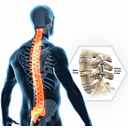
The company's lead and essentially only product is the NB1 device, a single-dose vial combining the recombinant protein NELL-1 (Neural Epidermal growth factor-Like 1), exclusively licensed from UCLA in 2006, freeze-dried onto demineralized bone matrix (DBM). It is designed for lumbar interbody spinal fusion in patients with degenerative disc disease. In 2024, the company began its first human pilot clinical study in Australia, a multicenter, prospective, randomized trial enrolling up to 30 patients to evaluate NB1's safety and fusion success, with results expected roughly 12 months after the final patient is enrolled. The company has stated longer-term ambitions to expand NELL-1-based products into trauma non-union and osteoporosis applications, but these remain conceptual.
Competitive Landscape
Bone Biologics faces direct competition from large, well-capitalized orthopedic and spine companies including Medtronic, Stryker, Globus Medical, and DePuy Synthes (Johnson & Johnson), all of which sell established bone-graft substitutes and spinal fusion technologies with far greater R&D, sales, and regulatory resources. Bone Biologics has no approved product and no commercial infrastructure, putting it at a severe scale disadvantage versus these incumbents.
Strategic Strengths & Risks
The only meaningful strength is its exclusive license to NELL-1, a differentiated growth-factor mechanism that, if proven safe and effective, could compete with existing bone-graft substitutes (like BMP-based products) that have had documented safety concerns. Risks dominate the picture: the company's auditors have expressed substantial doubt about its ability to continue as a going concern; it has accumulated losses of approximately $85 million since inception with a 2024 net loss of $4.1 million; available cash was expected to fund operations only through Q4 2025, meaning it likely needs (or needed) further dilutive financing; it has no revenue and is years away from a PMA decision even if trial results are positive; and it depends heavily on a tiny two-person management team plus outside consultants for all regulatory, clinical, and manufacturing functions.
Financial Overview
Market capitalization is approximately $2.24 million — a micro/nano-cap reflecting its pre-revenue, going-concern status. Accumulated deficit since inception is approximately $85 million; 2024 net loss was $4.1 million. The company generates no product revenue.
Summary Conclusion
Bone Biologics is a speculative, pre-revenue clinical-stage medical device company whose entire value proposition rests on NELL-1 succeeding in an early-stage Australian clinical trial and eventually winning FDA approval against much larger incumbents — a high-risk, binary outcome company with explicit going-concern doubt and a de minimis market capitalization.